
Grind Texas Blog
Epsom Salt Stump Removal: Does It Actually Work?
Search “kill a tree stump” and Epsom salt is the first remedy you'll meet: drill holes, pack in the salt, add water, cover, wait. It's cheap, it's non-toxic, and every gardening forum swears by it. Here's the honest version from people who grind out the stumps it didn't kill.
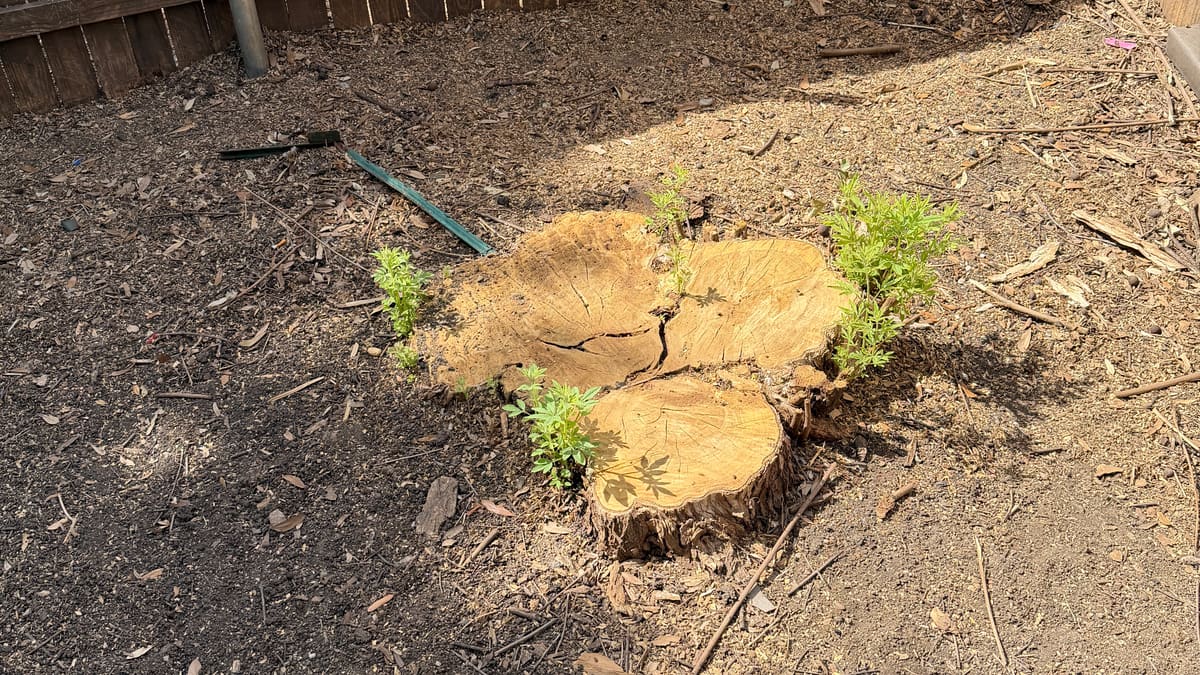
What Epsom salt actually does
Epsom salt is magnesium sulfate. Packed into drilled holes in high concentration, it draws moisture out of the wood and interferes with the stump's ability to move water — slow desiccation, not poisoning. (That's also why it “works” in the first place: in normal doses it's a fertilizer.) The standard method: drill the widest, deepest holes you can, pack them, wet lightly, tarp the stump, and repeat every few weeks.
How long it really takes
On a small stump — an ornamental, a young tree — a full growing season is a realistic best case. On a mature shade-tree stump with a big root crown, expect a year or more, with reapplication, and a real chance the crown outlasts your patience and resprouts anyway. And when it does finally die: the stump is still there. Epsom salt kills; it doesn't remove. You're then on the natural rot timeline measured in years.
Don't substitute rock salt
One warning worth repeating: regular salt (sodium chloride) will also kill a stump — and poison the soil around it, so grass and plants struggle there for years. If you try the salt method at all, Epsom salt only, and keep it in the stump, not the soil.
When it's genuinely worth trying
Small stump, zero budget, zero hurry, and you'd rather not use herbicide — Epsom salt is a defensible experiment. Everything bigger or faster, look at the full menu of methods. For comparison: grinding takes the same stump — plus the living crown that regrows — out below grade in about an hour, no waiting, no chemistry. Curious what that costs for yours? Text a photo to (940) 293-2715 and we'll send a real number in minutes.